Make AI video copyright-eligible.
Other studios make AI video. We made the AI commercial the U.S. Copyright Office registered — PAu 4-297-548, March 2026. RenderLux is the workflow that earned the registration. Hand-drawn boards. ControlNet-guided generation. Documented human authorship at every step. Backed by formal legal opinion from Lorium PLLC.
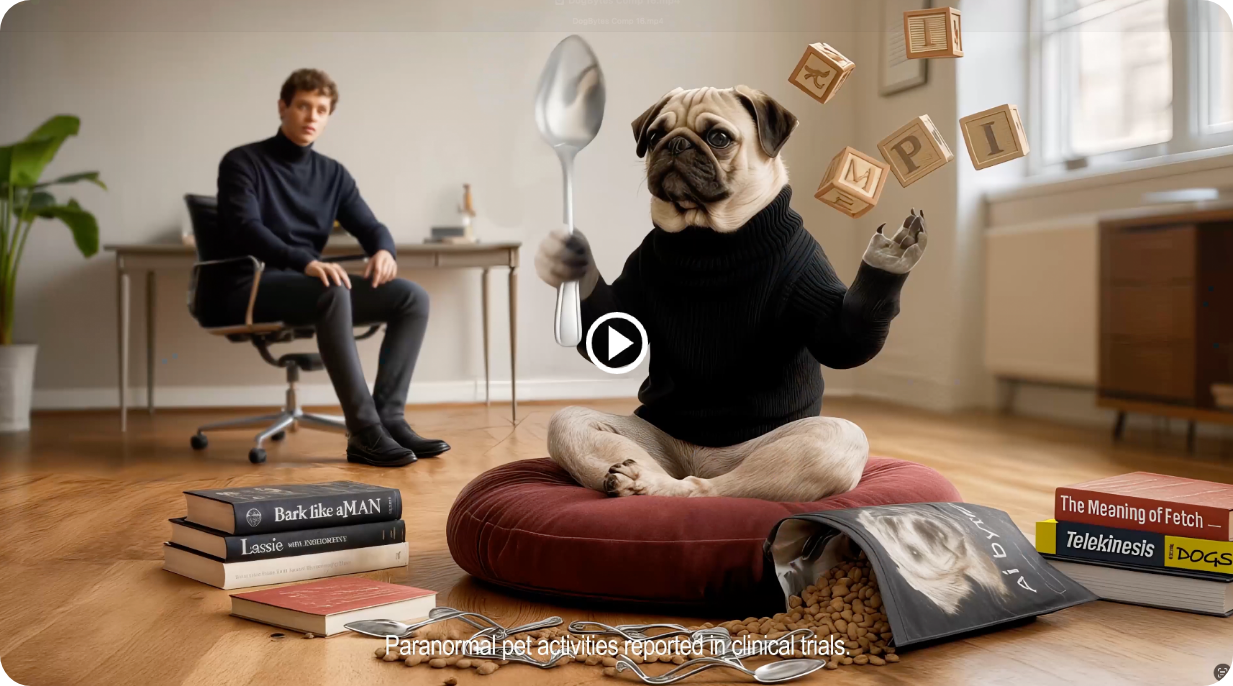
AI Bytes: The Breakthrough Session.
A self-produced spec commercial. Submitted to the U.S. Copyright Office under the RenderLux workflow. Registered as PAu 4-297-548 on March 28, 2026 — the first AI-finished commercial registered with the Office. Verifiable on the public record.
 U.S. Reg. PAu 4-297-548
A spec spot. Built to test the workflow.
- :30 broadcast-format commercial
- Self-produced, no client involved
- Built to demonstrate the workflow
- Submitted for U.S. registration
14 days from concept to delivery.
- Days 1–3: hand-drawn boards
- Days 4–7: ControlNet generation
- Days 8–12: editorial & sound
- Days 13–14: documentation package
PAu 4-297-548. Public record.
- Issued March 28, 2026
- U.S. Copyright Office
- Documented authorship throughout
- Lorium PLLC legal opinion on file
The work is not about the funny dog. It is about the Human Oversight Verification package that came with it. Every frame is documented for copyright-eligibility through human authorship.
More work shipping in 2026. A new project added every two weeks. Bookmark, or subscribe to the dispatch.
Twenty-eight years of pre-production for the creative departments of —
The studio that earned the registration is the same studio that drew the boards Spielberg signed for Progressive's 1999 Super Bowl spot. RenderLux is not an AI startup with a workflow. It is twenty-eight years of agency-room production discipline applied to AI.
If we cannot own it,
can we air it?
Every CMO asks the same question.
Pure text-to-video AI output is not registrable.
The U.S. Copyright Office requires human authorship. Without it, no registration. Competitors can run identical work next to yours.
That is the legal reality of most AI commercial production today.
RenderLux is how we address it.
By documenting the human creative direction at every step. Hand-drawn boards establish authorship. ControlNet preserves the artist's compositional intent. The Human Oversight Verification package is the audit trail.
The U.S. Copyright Office accepted it. PAu 4-297-548.
A brand that runs undocumented AI commercial work is a brand that has spent media budget on something a competitor can copy without consequence. Animatic Media built RenderLux to close that gap. The proof is on the public record.
Why RenderLux is different.
Three approaches to AI commercial production. Only one has produced a U.S. Copyright Office registration. The differences land on the rows that matter for a brand making real media spend on the output.
| Text-to-video AI | Other AI studios | RenderLux | |
|---|---|---|---|
| U.S. Copyright registration | Not registrable | No registered work | PAu 4-297-548 issued |
| Documented human authorship | None | Inconsistent | Every step recorded |
| Hand-drawn board foundation | No | Some | Always |
| Formal legal opinion | N/A | None published | Lorium PLLC, on file |
| Human Oversight Verification package | No | No | Delivered every project |
| Agency-room heritage | N/A | Recent (typically <5 years) | 28 years (since 1997) |
| Standard turnaround | Hours | 5–10 days | 14–20 days |
RenderLux takes longer than other AI workflows because the documentation is what registration requires. The extra days are the difference between a video that runs and a video built to support registration. Registration is assessed per work: the U.S. Copyright Office reviews each application on its own facts.
How RenderLux works.
A documented production workflow that merges familiar agency-room standards with AI generation. Every step is recorded. The recording is what makes the work registrable.
Begin with human artistry.
Every project begins with hand-drawn boards by the studio's visualizers. The boards establish creative intent, composition, and human authorship before any AI is touched. The boards are the legal foundation.
Generation, under direction.
Hand-drawn frames run through ControlNet-guided generation, which preserves compositional intent rather than generating freely from a text prompt. The artist's hand is the constraint. The AI is the finishing tool.
Image-to-video, finished by humans.
Producer-directed image-to-video extension and editorial finishing. Timing, voice direction, sound design, and color all run under direct human creative supervision. Documented at every step.
The Human Oversight Verification package.
Every prompt, sketch, human edit, and creative decision recorded. Original boards. ControlNet inputs. Producer notes. Authorship declaration. The package travels with the finished video. It is what supports the registration application.
One registration. And the heritage that earned it.
RenderLux is a young workflow built on top of an old studio. The numbers below are the foundation under the methodology.
A brand that runs undocumented AI commercial work has spent media budget on something a competitor can copy without consequence. RenderLux closes that gap.
The principle behind PAu 4-297-548
RenderLux questions, answered straight.
Not in here? Email hello@animaticmedia.com. We answer in one business day.
Can AI-generated video be copyrighted?+
Pure text-to-video output, generated without documented human creative direction, is not currently registrable for copyright protection in the United States. The U.S. Copyright Office has consistently held that copyright requires human authorship. AI-finished video can be copyright-eligible when the human creative contribution is substantial, documented, and verifiable — and when the work is presented with that authorship record at the time of registration. RenderLux is the workflow Animatic Media developed to meet that standard. The first AI-finished commercial registered with the U.S. Copyright Office, AI Bytes: The Breakthrough Session, was produced under it. Registration PAu 4-297-548.
What is RenderLux?+
RenderLux is the proprietary AI video production workflow developed by Animatic Media that makes AI-finished commercial work eligible for U.S. Copyright Office registration. The workflow begins with hand-drawn boards by the studio's visualizers, translates those boards to photoreal output through ControlNet-guided generation under direct human creative supervision, and documents every prompt, sketch, and human edit in a Human Oversight Verification package. The methodology is backed by formal legal opinion from Lorium PLLC and was validated by the issuance of U.S. Copyright Registration PAu 4-297-548.
What is U.S. Copyright Registration PAu 4-297-548?+
PAu 4-297-548 is the U.S. Copyright Office registration number issued for AI Bytes: The Breakthrough Session, a self-produced spec commercial by Animatic Media. The registration was issued March 28, 2026. It is the first AI-finished commercial video registered with the U.S. Copyright Office. The registration is publicly verifiable at the U.S. Copyright Office search portal.
How is RenderLux different from text-to-video AI?+
Text-to-video AI generates output from a written prompt with no documented human creative authorship of the resulting frames. The output is not currently eligible for copyright registration in the United States. RenderLux begins with hand-drawn boards composed by human visualizers, uses ControlNet to translate those boards to photoreal output while preserving compositional intent, and documents each step. The result is a video with verifiable human creative direction at every stage — which is the condition the U.S. Copyright Office requires for registration of AI-assisted work.
How is RenderLux different from other AI video studios?+
Other AI video studios produce AI-finished commercial work but have not registered any of it with the U.S. Copyright Office. RenderLux has. PAu 4-297-548 is the public, verifiable proof. The methodology is also backed by formal legal opinion from Lorium PLLC, which is a separate credential that other AI studios do not currently publish. Beyond the legal posture, Animatic Media brings 28 years of pre-production heritage from Goodby Silverstein, TBWA\Chiat\Day, Wieden+Kennedy, BBDO, BBH, Ogilvy, Droga5, and Adam & Eve/DDB — agency-room standards no other AI studio can match.
What is the Human Oversight Verification package?+
Every RenderLux project ships with a Human Oversight Verification package — a documentation set that records the human creative input behind the AI-finished video. It includes the original hand-drawn boards, the prompts used at each ControlNet generation step, the producer's creative direction notes, the sketch-to-frame authorship record, and a signed authorship declaration. This documentation is what supports the work's eligibility for U.S. Copyright Office registration. The package is delivered to the client alongside the finished video.
Will registration be guaranteed for every RenderLux project?+
Registration eligibility cannot be guaranteed in advance for any work — the U.S. Copyright Office reviews each application on its own facts. What RenderLux delivers is a workflow that has produced a successful registration once (PAu 4-297-548) and the documentation package needed to support a registration application on equivalent grounds. Animatic Media facilitates the registration process for client projects produced under the workflow but does not provide legal counsel — for filing strategy and registration advice, clients should retain copyright counsel directly. Lorium PLLC issued the formal legal opinion underpinning the workflow.
Who is Lorium PLLC and what is their role?+
Lorium PLLC is the law firm that issued the formal legal opinion supporting the RenderLux workflow's compliance with U.S. Copyright Office authorship requirements. The opinion analyzes each step of the workflow against current U.S. Copyright Office guidance on AI-assisted authorship and identifies the documentation that satisfies the Office's human-authorship standard. The opinion is the legal foundation for the workflow.
How is RenderLux pricing structured?+
RenderLux pricing is scoped per project. The workflow includes hand-drawn board production, AI-photoreal frame generation, full editorial finishing, the Human Oversight Verification documentation package, and registration support — bundled rather than tiered. Project scope drives cost. We recommend a 30-minute call to scope properly. Brands and agencies that prioritize copyright-eligible AI video budget for it as a premium tier above standard AI production because the legal documentation is what they're buying.
What turnaround should I expect for a RenderLux project?+
Standard turnaround is 14 to 20 business days from approved script. The hand-drawn board phase runs in parallel with style approval. ControlNet-guided generation lands in days four to ten. Editorial finishing and documentation package assembly close the schedule. Pitch-cycle rush work is possible — call us and we will tell you what is achievable.
Can RenderLux produce AI commercials, AI social content, or AI explainer video?+
Yes to all three. The workflow is format-agnostic at the output stage — the same documented-authorship process supports broadcast commercials (the AI Bytes registered work was a broadcast-format commercial), 9:16 vertical social content for Reels and TikTok, and explainer video for B2B and consumer brands. The legal documentation package is identical across formats.
Where is Animatic Media based?+
A global studio with remote offices in Palm Beach, London, and Los Angeles. SAM.gov-registered for US federal work (UEI CKCTG4PXFCL5, CAGE 5ENQ7) under NAICS 541810. Active socioeconomic certifications: Native American–Owned, Minority-Owned, Veteran-Owned. For non-US engagements we work directly or through your existing agency structure.
Sometimes it takes more than a prompt.
If your brand is making real media spend on AI commercial work, the work needs to support ownership and registration eligibility. RenderLux is the workflow built to support ownership and registration. PAu 4-297-548 is the registered proof of the methodology. Two business days from your first email to a real estimate.