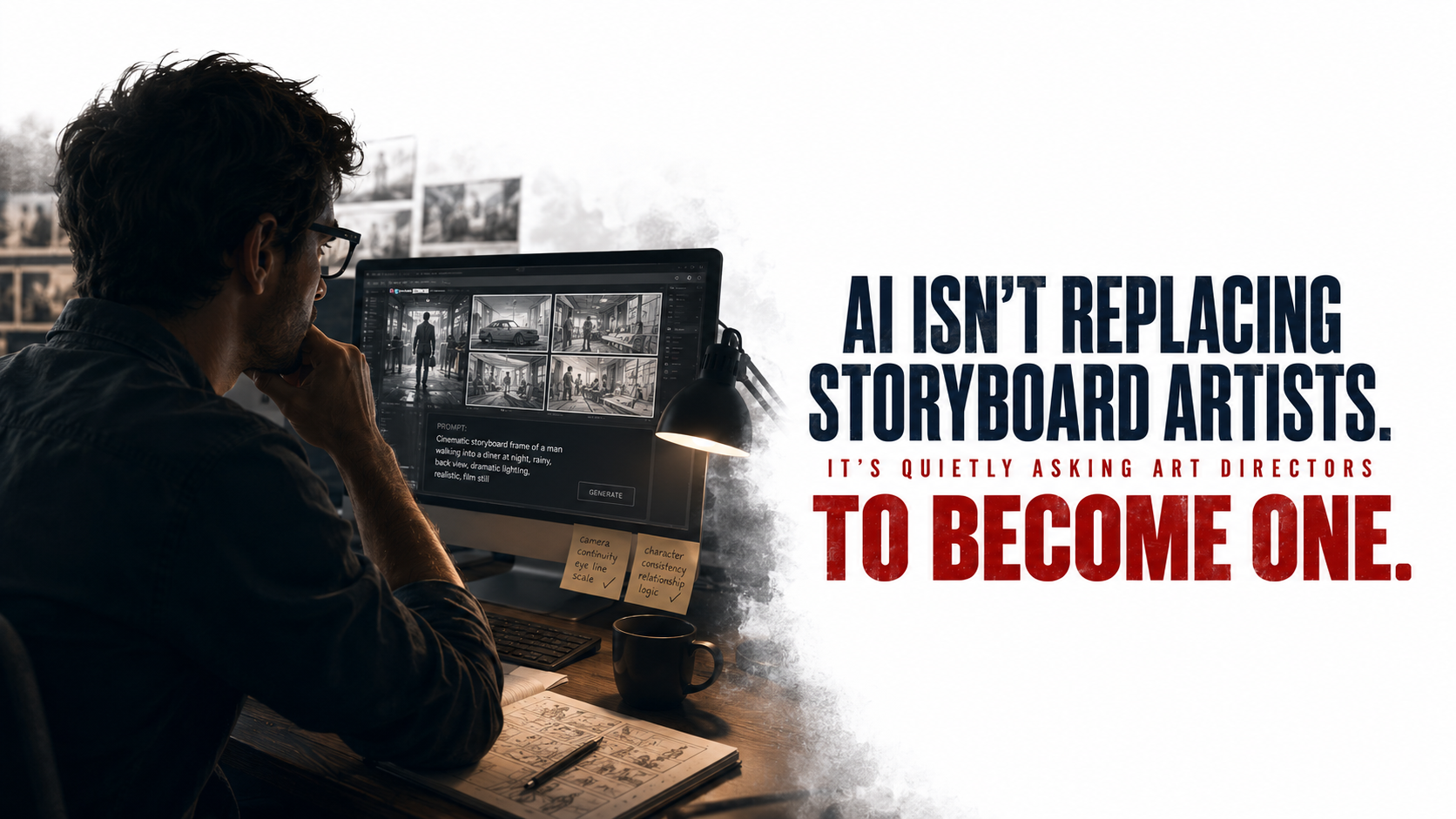
I recently asked a simple question on Fishbowl, a community full of agency creatives:
How are you handling continuity issues on AI boards?
I expected a conversation about prompts. Instead, I got a conversation about jobs.
The replies came fast.
Every answer sounded reasonable. Until I realized they all had one thing in common.
Every solution assumed the art director would do more work.
We solved one problem.
Everyone talks about character consistency. That fight is mostly over. Today's models can usually keep Character A looking like Character A.
That's no longer what slows projects down.
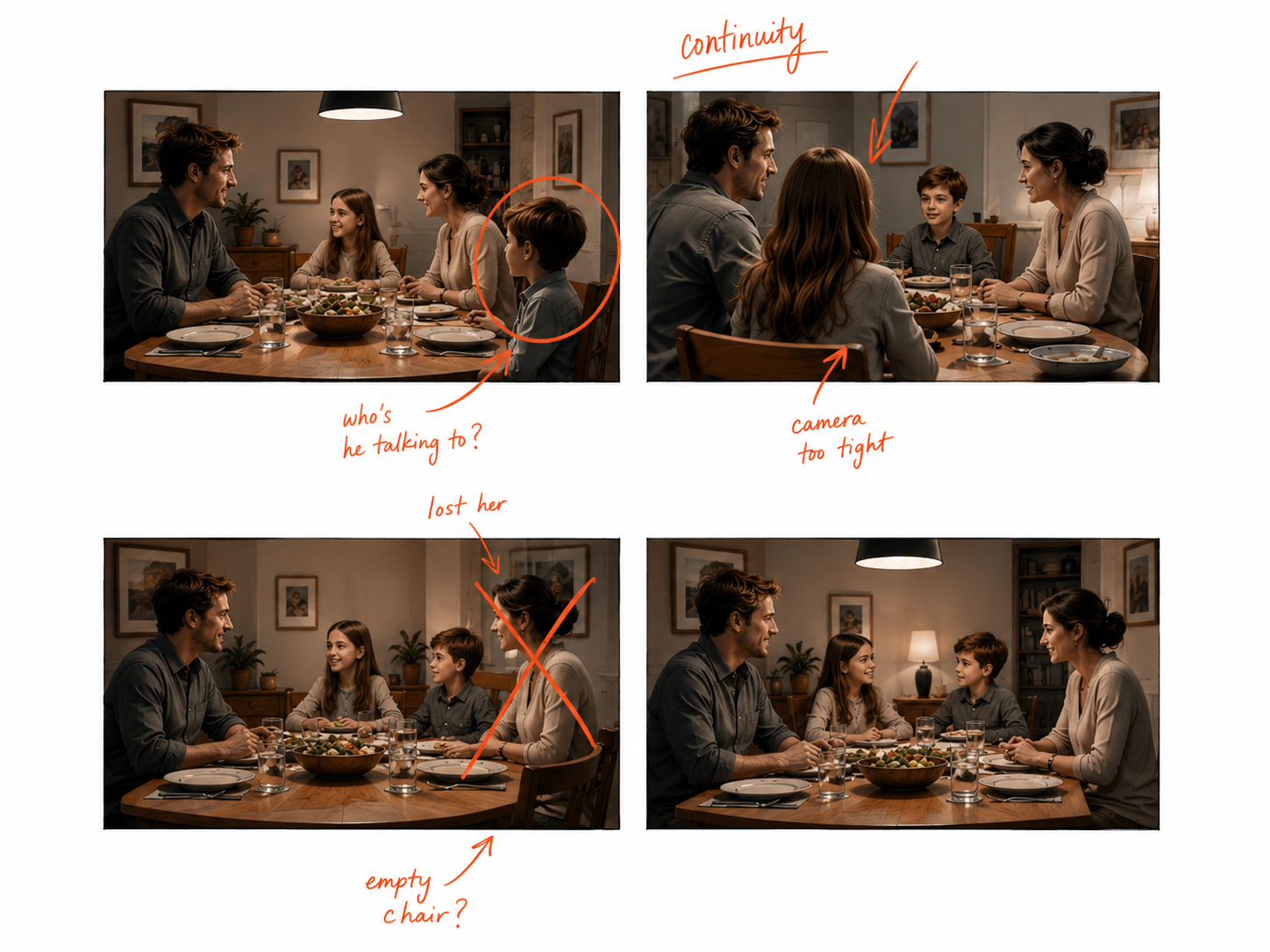
The new problems are continuity, spatial relationships, storytelling, scale and perspective. Those don't exist inside a single frame. They exist between frames. That's where AI still struggles.
The hidden workflow nobody talks about.
Two years ago a commercial storyboard usually looked something like this.
Each person specialized. Each handed work to the next. AI was supposed to simplify that. Instead, it quietly became this.
The storyboard artist didn't disappear. Neither did the editor. Their work simply landed on someone else's desk.
The comments accidentally proved the point.
The Fishbowl responses were fascinating because nobody disagreed. Everyone offered practical advice.
Use better prompts. Use references. Label every character. Generate in and out frames. Use Photoshop. Keep regenerating.
They're all correct. They're also all additional jobs. None of those tasks existed for an art director three years ago.
"Just fix it."
One response really stood out.
"Why don't you simply fix them before they go out?"
It's a fair question. But who is "you"?
It's rarely production. It's rarely a storyboard artist. It's almost always the highest-paid creative on the project.
The person hired to solve the communication problem is now spending hours checking whether Mom switched sides of the dinner table.
AI didn't remove production work. It reassigned it.
This is the part I think our industry is still underestimating. AI absolutely makes images faster. But images aren't campaigns.
Commercials are sequences. Sequences have continuity. Spatial logic. Screen direction. Timing. Story. Someone still has to think across all of those. Today that's increasingly the art director.
There's a reason this matters.
The danger isn't that clients notice. Most don't.
The danger is that agency creatives stop spending their best hours on the work only they can do — ideas, strategy, concept development, performance. Instead they're masking layers. Fixing perspective. Matching eyelines. Rebuilding continuity.
Those are production problems. They're just wearing different clothes now.
AI isn't replacing storyboard artists. It's quietly asking art directors to become one. And often an animatic editor too.
That's probably the biggest change AI has made to commercial development. Not replacing creative jobs. Compressing four creative disciplines into one.